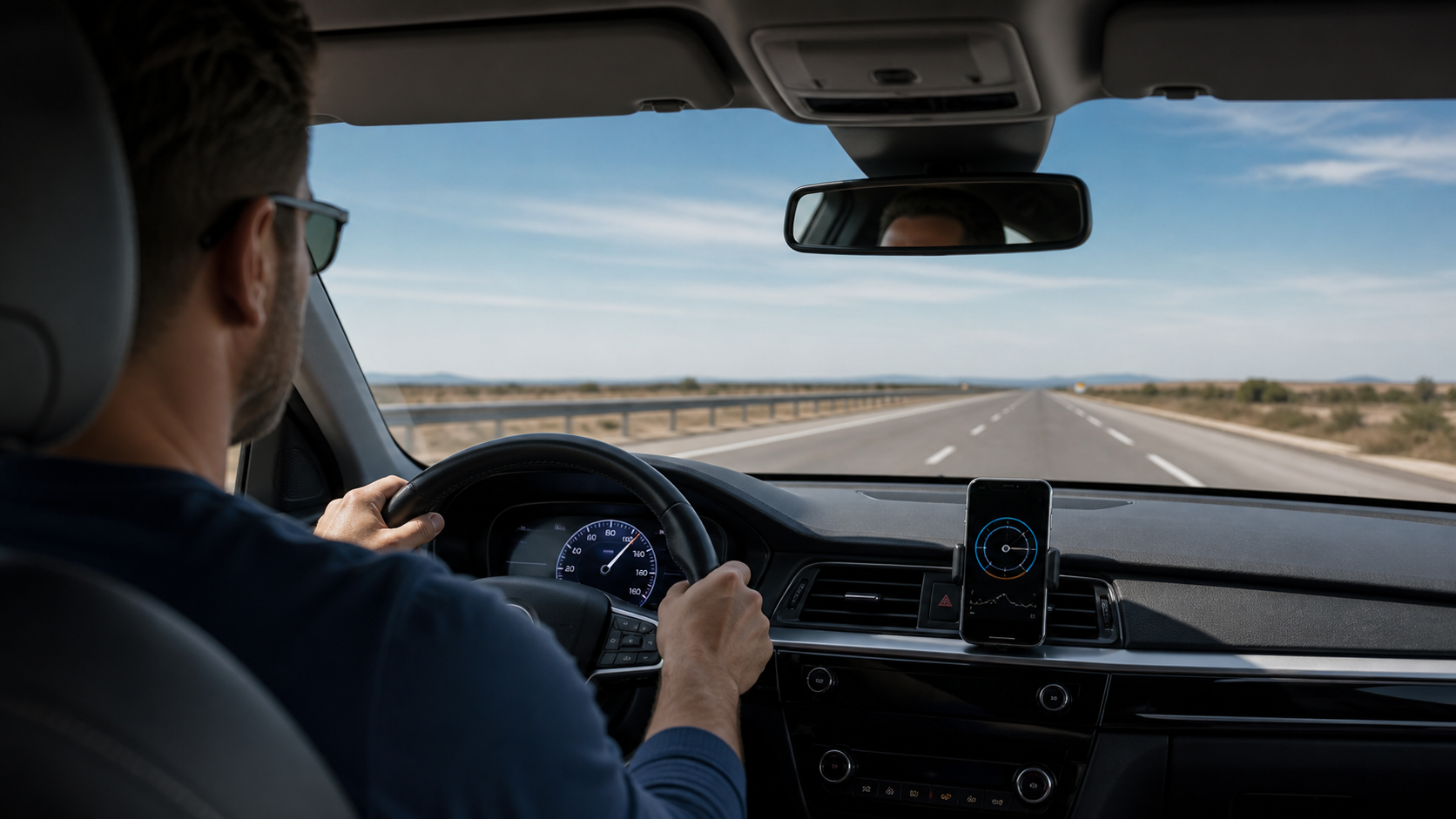
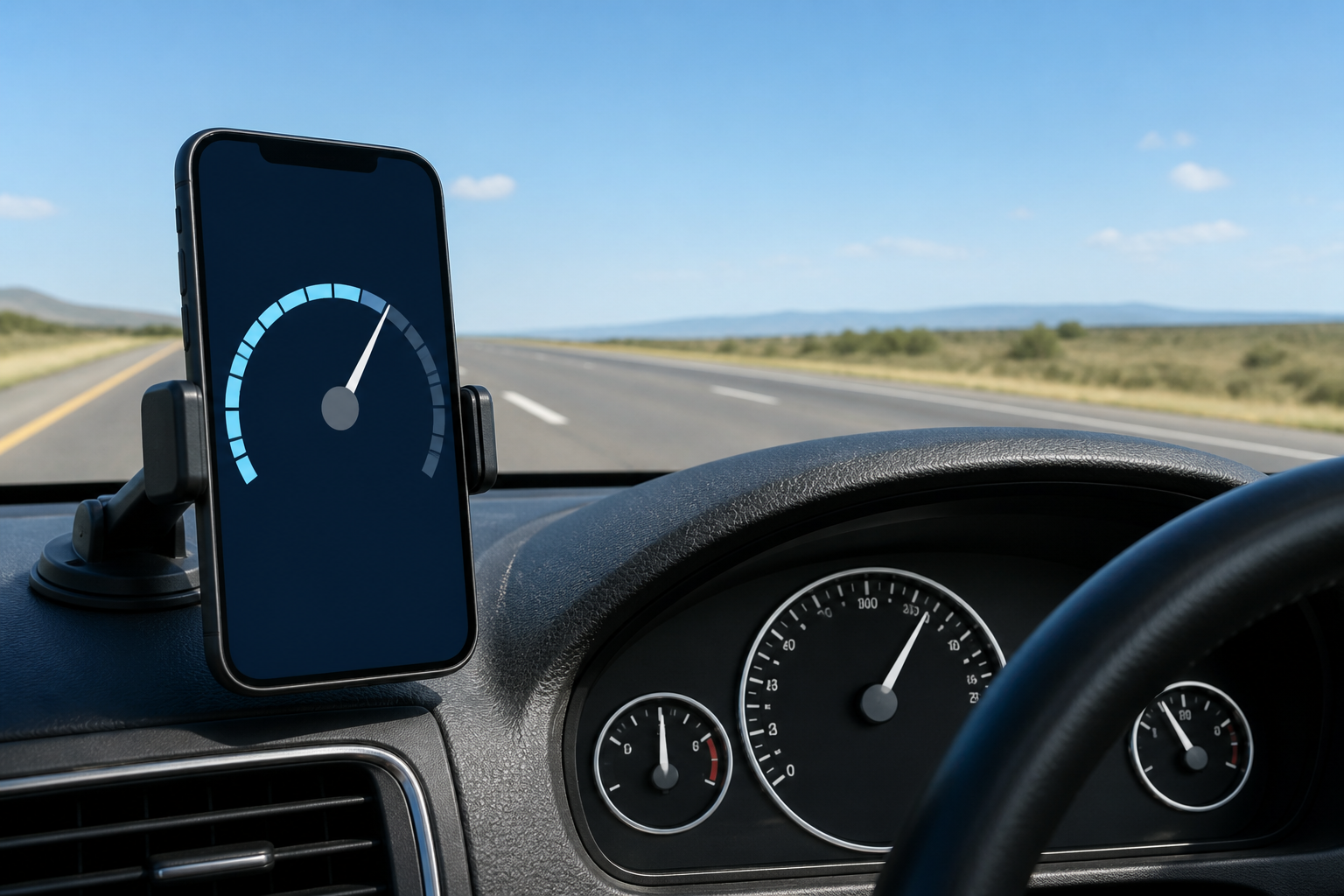
Set the cruise control to 65 mph on a clear highway and you may notice something odd: the dashboard says 65, while the GPS speedometer on your phone settles at 62 or 63. Nothing is necessarily broken. The two displays arrive at speed in different ways, and each has its own sources of error.
The short answer: at a steady pace with a clear view of the sky, a GPS speedometer is often a useful estimate of your actual speed over the ground. Your car's speedometer is quicker to react and keeps working in tunnels, parking structures, and other places where satellite reception struggles. Neither reading should be treated as perfect in every situation.
How a car speedometer measures speed
A modern car does not look at the road and measure how fast the vehicle moves across it. Instead, sensors track the rotation of the wheels or transmission. The car's computer converts those rotations into a speed using an assumed rolling circumference for the tires.
That assumption matters. A tire travels a certain distance with each revolution, but its effective size changes slightly as the tread wears, pressure changes, or a different tire size is fitted. A replacement wheel-and-tire package with a larger overall diameter covers more ground per rotation; a smaller one covers less. The dashboard can therefore drift even though its electronics are working exactly as designed.
Manufacturers also leave room for production tolerances and legal requirements in different markets. In practical terms, many dashboards are calibrated so they are more likely to read a little high than low. That is why a small, repeatable difference—perhaps two or three miles per hour at highway speed—usually is not a cause for alarm.
How a GPS speedometer works
A GPS receiver listens for precisely timed signals from several satellites. Once it has a reliable fix, it can estimate motion from changes in position and from the frequency shift of the satellite signals. Your phone then smooths those estimates and updates the number you see on screen.
This approach does not depend on tire size, tread depth, wheel slip, or the car manufacturer's calibration. That makes GPS especially useful when the vehicle is moving steadily on a straight, open road. It is also why the same browser-based tool can measure speed in a car, on a bicycle, or aboard a train.
GPS has limits of its own. Tall buildings can reflect signals before they reach the phone. Trees, bridges, mountains, tunnels, and some windshields can weaken the satellite view. A phone may also update only once every second, then smooth the result to prevent a nervous, constantly jumping display. During hard acceleration or braking, that delay is easy to spot.
The U.S. government notes that GPS-enabled smartphones are typically accurate to within about 4.9 meters (16 feet) under open sky, while buildings, bridges, and trees can reduce accuracy. That figure describes position rather than a promise that every speed reading will be exact, but it explains why the setting around the phone matters.
Why the two numbers do not match
A mismatch is usually the combined result of several small effects rather than one dramatic fault.
- Dashboard calibration: the indicated speed may be intentionally conservative.
- Tire condition: pressure, wear, temperature, and tire size change the distance covered per wheel revolution.
- Satellite visibility: an open highway is easier for GPS than a street lined with high-rise buildings.
- Display delay: GPS smoothing can lag behind rapid changes, while the dashboard responds almost immediately.
- The type of motion: curves, steep grades, wheelspin, and stop-and-go driving make a quick comparison less meaningful.
The pattern tells you more than a single glance. If the car consistently shows 65 mph while GPS holds around 62 on several open-road runs, you are probably seeing a stable calibration difference. If GPS leaps from 55 to 72 and back while the dashboard remains calm, the phone likely has a poor fix. If the gap appeared immediately after new wheels or tires were installed, check the overall tire diameter against the manufacturer's approved specification.
Which reading is more accurate?
It depends on the moment.
At constant speed on a straight road under open sky, GPS is often the better independent check of speed over the ground. It is not using the same wheel data as the car, so it can reveal a consistent dashboard bias. This is the situation most people have in mind when they ask which speedometer to trust.
During acceleration, braking, or a trip through a tunnel, the car's display is more useful. Its wheel sensors update rapidly and do not need satellite reception. The dashboard is also the instrument designed to be visible without turning a phone into a distraction.
There is an important distinction here: a useful comparison tool is not a legal excuse. Speed limits apply regardless of which display you prefer, and enforcement equipment is separate from both. If two readings disagree, drive to the lower, safer speed until you understand the cause.
A safe way to compare them
- Mount the phone before moving. Put it where it is easy to glance at without blocking your view. Never hold or adjust it while driving.
- Wait for a stable GPS fix. Start outdoors with a clear view of the sky and give the receiver a moment to settle.
- Choose the right road. Use a straight, level stretch with light traffic and a constant legal speed. Avoid tunnels, dense tree cover, and streets between tall buildings.
- Compare for 20 to 30 seconds. A sustained reading matters more than a one-second difference.
- Repeat at a few legal speeds. A consistent percentage gap can point to tire sizing; a fixed small gap may simply reflect calibration.
- Do not diagnose while driving. Have a passenger note the readings, or review them only after parking.
You can run this check without installing an app. Open the SpeedyMeter car speedometer, choose mph or km/h, allow location access, and keep the phone securely mounted. The tool also records maximum and average speed, distance, elapsed time, and a speed timeline, which makes a steady section easier to identify after the trip.
What can make the dashboard wrong?
Start with the tires. Confirm that all four match the approved size on the door-jamb label or owner's manual, then set cold pressure to the manufacturer's recommendation. Do not use the maximum pressure printed on the tire sidewall as the car's target pressure.
Next, consider recent changes. New aftermarket wheels, unusually worn tires, or a temporary spare can alter the rolling circumference. Some vehicles can be recalibrated for a different approved tire size; others require a dealer or qualified technician.
A large or suddenly changing error deserves attention. If the dashboard drops out, behaves erratically, or disagrees by an amount far beyond the small gap you normally see, the cause could be a wheel-speed sensor, wiring fault, instrument-cluster issue, or incorrect vehicle coding. That is a repair problem, not something a GPS page should be used to mask.
What can make GPS wrong?
Look at the environment before blaming the phone. Urban canyons are notorious for reflected signals. A tunnel blocks the satellite view completely. Dense foliage and mountain walls can also create a weak or lopsided geometry between the receiver and the satellites.
Phone settings matter as well. Battery-saving modes may reduce location update frequency. A browser without location permission cannot provide a reading, and an older device may take longer to settle. If the result seems implausible, stop safely, confirm that precise location is enabled for the browser, and test again in open space.
Low speeds are another awkward case. A small position change represents a large proportion of the distance traveled, so walking-pace readings may wander more than highway readings. GPS is at its best as a sustained-speed measurement, not as a laboratory instrument for every split second.
The practical verdict
Think of the two displays as complementary. The car speedometer is the immediate, always-there driving instrument. GPS is an independent reference that can expose a consistent offset when conditions are good.
If your dashboard reads slightly higher than GPS at a steady highway speed, that is common. Check tire size and pressure, repeat the comparison safely, and watch for consistency. If the difference is large, appeared suddenly, or changes unpredictably, have the vehicle inspected.
For the cleanest comparison, try the SpeedyMeter GPS speedometer on an open road with a passenger watching the display. Use the result as information—not as a reason to drive faster.
Sources and further reading
This article is general information, not a substitute for vehicle inspection or local traffic law. Always follow posted speed limits and local rules on phone use while driving.